The Ten Most Critical Risks for All Global Enterprises
- Oct 7, 2025
- 3 min read
Updated: Nov 19, 2025
Risk is the be-all-end-all for every single business in every single country around the globe.

Do You Know Your Risks?
Risk is the be-all-end-all for every single business in every single country around the globe. Risk exists in the open air but also exist tucked into corners that often go unnoticed - before it’s too late.
The most critical risks for multinational corporations are not just financial—they span political, regulatory, operational, technological, and reputational domains. The complexity comes from how interconnected they are; a political disruption can trigger supply chain issues, which may amplify financial losses and reputational damage.
To download the full report, click below
Top 10 Most Crucial Risks for all Global Enterprises

Regulatory & Compliance Risks
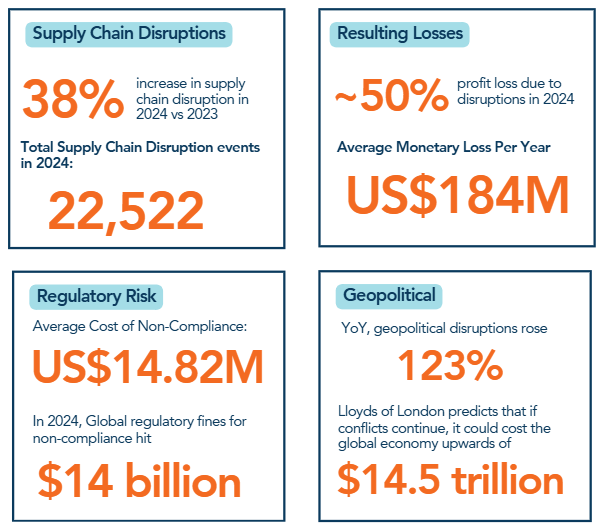
Operating across borders means adapting to complex laws and regulations. Non-compliance can lead to heavy fines, damaged relationships, and lost growth — making strong governance and local expertise essential.
Political & Geopolitical Risks
Political uncertainty creates an unpredictable business environment. Global corporations face risks of expropriation, nationalization, or sudden policy shifts that can significantly affect investments. Political instability — from leadership changes to sanctions — can disrupt markets, investments, and supply chains. To stay resilient, corporations need strong contingency plans and diversified operations.
Economic & Currency Risks
Global enterprises face shifting exchange rates, inflation, and uneven economic cycles that impact revenue and costs. To protect margins, they rely on currency hedging, financial risk management, and close monitoring of global market trends.
Taxes & Cross-Border Financial Risks
International tax systems are complex and ever-changing. Multinationals must manage transfer pricing, double taxation, and shifting enforcement. Transparent tax strategies and strong legal frameworks help reduce financial and reputational risk.
Supply Chain & Logistics Risks
Global supply chains are increasingly fragile. Disruptions from disasters or conflict can halt operations and cut profits by up to half. To stay resilient, companies need visibility, diversified sourcing, and flexible logistics networks.
Cyber & Technology Risks
As enterprises digitize globally, cyberattacks pose major strategic risks. Ransomware, espionage, and privacy law violations can cost millions and damage reputations. Strong cybersecurity, continuous monitoring, and employee training are essential defenses.
Operational & Workforce Risk
Managing a multinational workforce involves navigating labor laws, safety standards, and cultural differences. Strikes, skill shortages, or unrest can disrupt operations, so prioritizing engagement, health, and safety is key to resilience and retention.
Reputation & ESG Risk
In this increasingly interconnected world, business reputation is paramount. How companies handle environmental, social, and governance (ESG) issues now directly affects public trust and investor confidence. Failures in sustainability or ethics can trigger boycotts, activist campaigns, and divestment. Strong reputation management means going beyond compliance with transparent policies and proactive reporting. Organizations that lead in ESG are better able to attract customers, investors, and top talent globally.
Insurance & Risk Transfer Gaps
Multinational corporations face major insurance challenges when policies from one country aren’t recognized in another. Navigating admitted and non-admitted coverage is vital, and partnering with global advisors ensures compliance and effective risk protection.
Catastrophic & Natural Disaster Risk.
Global enterprises face climate change and natural disasters that can halt operations and disrupt supply chains. Resilience requires geographic diversification, scenario planning, and strong continuity strategies, with insurance and proactive risk mitigation playing key roles.
Resilience planning requires geographic diversification, scenario testing, and investment in business continuity strategies. Insurance plays a critical role, but proactive risk mitigation is equally important as climate-related disruptions increase in both frequency and severity.
By no means is this an exhaustive list of all existing risks, but these are the top ten more crucial risks that should be addressed before anything else.
Get the WMB Difference
Need Help?
Contact Wilson M. Beck Global Risks to discuss how to protect your business from uncontrollable risk.
We specialize in helping insurers and their clients navigate the complex landscape of digital transformation. By assessing an organization’s current technology infrastructure, operational workflows, and risk exposure, they identify key areas where digitization can improve efficiency, accuracy, and customer engagement.
Our team provides tailored strategies for implementing digital solutions—ranging from advanced data analytics and AI-driven underwriting to seamless customer experience platforms—while ensuring regulatory compliance and risk mitigation.
By combining industry expertise with practical, actionable guidance, Wilson M. Beck enables insurers to modernize operations and empowers clients to benefit from more efficient, transparent, and personalized insurance services. Their approach ensures that digital initiatives align with both business objectives and evolving market expectations.

We Care. We Help.

Comments