
MARKET UPDATE: Ethiopia - New Levies to Support Disaster Risk Response Fund
- Mar 9
- 2 min read

To download the full document, click below
REGULATORY UPDATE SUMMARY
On 31 January 2026, it was reported that a new decree issued by the Council of Ministers will take
effect in February, directing levies on bank loans, insurance premiums and other sources into the
newly created Disaster Risk Response Fund. Insurance companies will be required to contribute
1% of all monthly premiums to the Fund.
The decree takes effect in February 2026 and is intended to create a centralized, predictable financing mechanism for disaster preparedness and humanitarian response.
Background Context
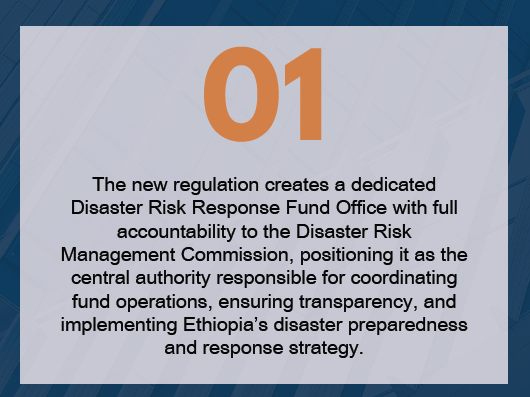
Key Structural Elements to this regulatory update include:


What Does This Mean for Multinational Insurance?
The new Disaster Risk Response Fund decree introduces significant obligations for Ethiopia’s financial and insurance sectors, embedding private institutions directly into national disaster financing. By mandating contributions from insurers, banks, and fintech companies, the regulation not only expands the country’s funding base for disaster preparedness but also creates new operational, compliance, and financial considerations for industry participants.
FINANCIAL & INSURANCE SECTOR IMPACT
Insurers must surrender 1% of premiums, aligning the industry with broader risk-pooling responsibilities
Banks must contribute 1% of loan values while Fintech income faces a 5% levy
ECONOMIC IMPLICATIONS
Possibility of cost pass-through to customers
Concerns regarding administrative enforcement capacity
Likelihood of cumulative regulatory burden on heavily supervised sectors
Global Impact of Ethiopia's New Levies:

Implications for Multinational Insurance Programs
Ethiopia's new levies will have a number of implications on global, multinational insurance programs:

Strategic Takeaway
This decree signals a structural evolution in sovereign disaster financing; one that embeds insurers directly into national resilience frameworks. For multinational organizations, the development reinforces three realities:
Regulatory costs tied to climate resilience are rising.
Insurance is increasingly viewed as public financial infrastructure.
Jurisdictional divergence will continue to shape global program design.
Expect more governments - particularly climate-exposed economies - to formalize disaster funds with mandatory industry contributions, gradually redefining the boundary between insurance markets and public risk financing.

Get the WMB Difference
Need Help?
Contact Wilson M. Beck Global Risks to discuss how to protect your business - wherever it takes you.
Wilson M. Beck Global Risks Inc. is a boutique division of Wilson M. Beck Insurance Services, offering tailored insurance and risk management solutions backed by over 100 years of combined experience.
Our team delivers personalized service rooted in trust, collaboration, and genuine care, ensuring every client feels understood, supported, and confident in their protection.
Our specialization in multinational insurance and corporate risk solutions is designed for mid-sized to large organizations that demand personalized service, specialized expertise, and seamless execution – wherever your business grows.
Contact Wilson M. Beck Global Risks to find out more about how our team of global experts can protect your operations and help keep you resilient, compliant, and in business.

We Care. We Help.


Comments